Omaha (PLO) Odds Calculator App
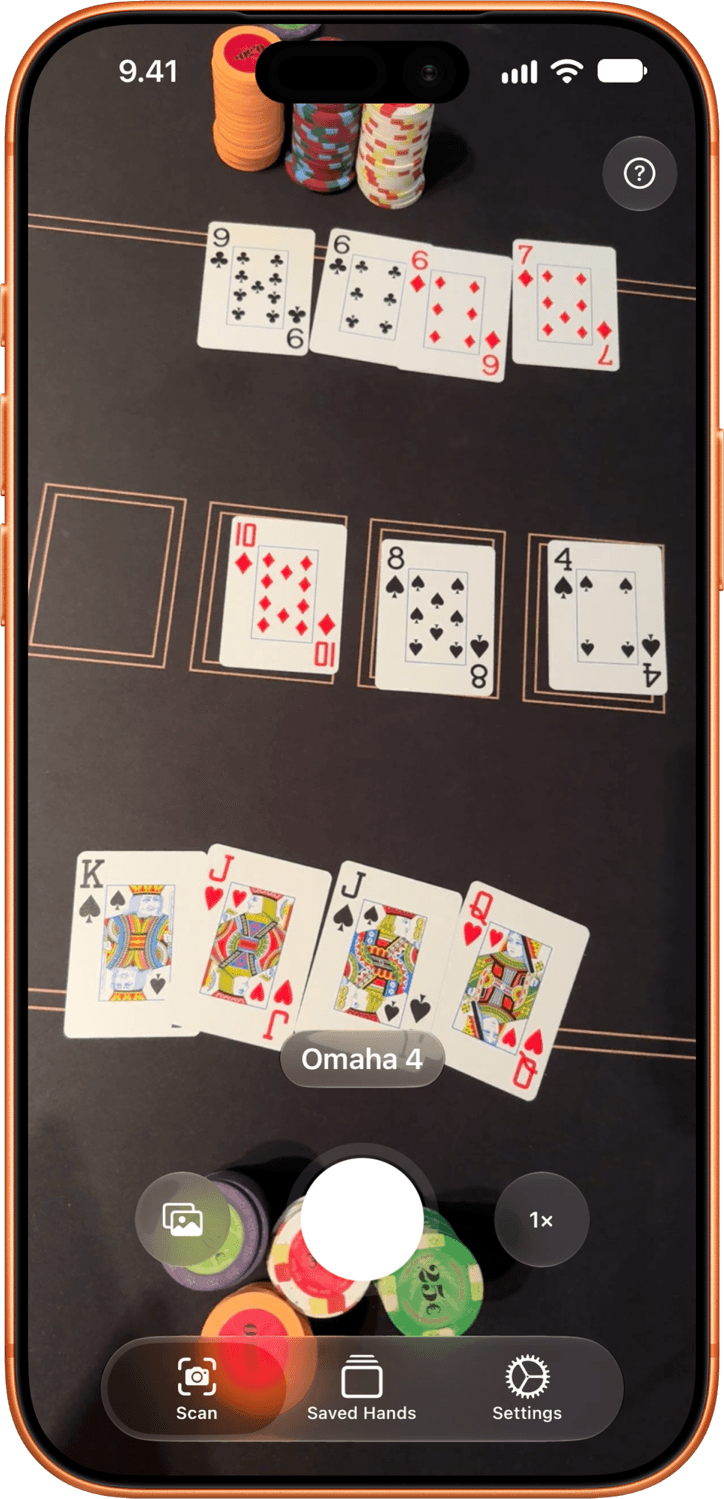
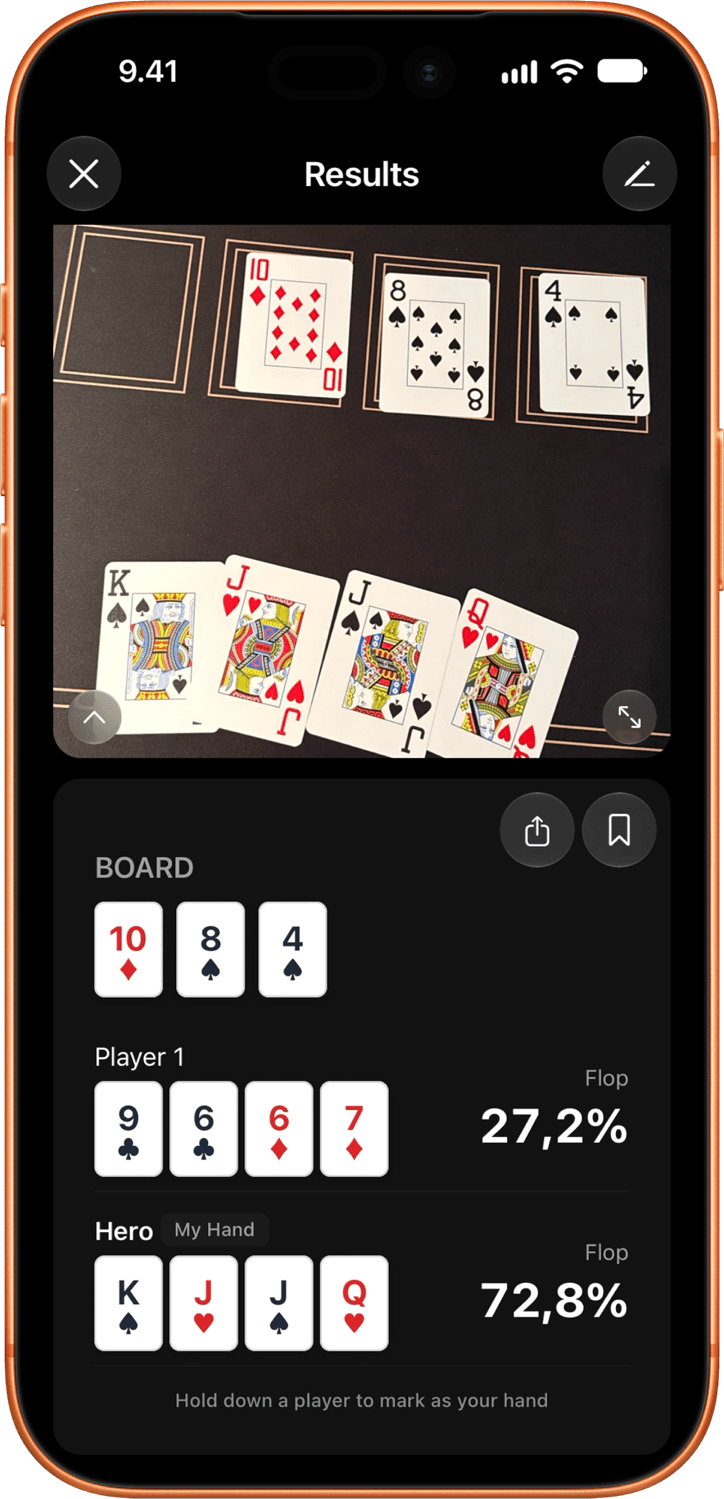
Handsight is an iPhone app that reads every player's four hole cards and the board with your camera, then shows each player's Omaha equity. You don't type in a single card.
- Take a photo of the PLO table, hole cards and board
- On-device AI reads every card, up to 6 players
- See each player’s equity in under two seconds

Free 7-day trial · iPhone
Pot-Limit Omaha is the second most popular poker game and the fastest growing format in both live and online poker. With four hole cards instead of two, PLO creates far more possible hand combinations, bigger pots, and closer equity between players. This makes an Omaha odds calculator not just useful but essential.
Why Omaha Odds Are Harder to Calculate
In Hold'em, two hole cards create one possible five-card hand. In Omaha, four hole cards create six possible two-card combinations, each of which pairs with the five community cards differently. This sixfold increase in starting combinations cascades through every street.
On a Hold'em flop, you evaluate one hand against the board. On a PLO flop, you evaluate six sub-hands. Multiply that by the number of opponents and the possible runouts, and the calculation becomes orders of magnitude more complex. This is why approximation shortcuts like the rule of 2 and 4 break down in Omaha because there are too many variables.
Key Differences Between Hold'em and PLO Equity
- Equities run closer together. In Hold'em, AA vs KK is an 80/20 matchup. In PLO, the best starting hand rarely has more than 65% equity against the second-best. This means you get it in bad less often, but you also have thinner edges.
- Draws are more powerful. With four cards, wrap straight draws (which have up to 20 outs) and combo flush-straight draws are common. These mega-draws can have more equity than made hands.
- Position matters more. Because equities are closer and draws are more numerous, the informational advantage of acting last is amplified in PLO.
- Nut hands dominate. The two-card rule in Omaha (you must use exactly two hole cards) means second-best hands lose more often. Nut flush over second nut flush, nut straight over lower straight.
Monte Carlo Simulation for PLO
Because exact equity calculation in PLO requires evaluating an enormous number of possible outcomes, Handsight uses Monte Carlo simulation. This technique works by dealing out thousands of random complete boards and tracking which player wins each time.
With enough simulations (Handsight runs thousands per calculation), the observed win rates converge on the true equity with high accuracy. Many desktop equity calculators use the same approach. Handsight runs it entirely on your device in under two seconds.
Common PLO Equity Scenarios
Here are some situations where knowing your Omaha equity changes your decisions:
- Wrap draw vs top set on the flop: A 20-out wrap can have 50%+ equity against a set. In Hold'em, sets are near-invincible on the flop. In PLO, they are vulnerable.
- Nut flush draw + pair vs two pair: Combo draws in PLO routinely have 40-55% equity against made hands. Folding these draws is often a mistake.
- Four-way all-in preflop: In a multiway PLO pot, the best hand might only have 30-35% equity. Understanding this prevents you from overvaluing premium hands.
How Handsight Works for Omaha
Handsight detects all visible cards on the table, including each player's four hole cards and the community cards, through your phone camera. The AI card detection works with any standard deck, in any lighting condition, at any angle.
Once detected, the Monte Carlo engine calculates equity for every player simultaneously. Up to 6 players in PLO, with results in under two seconds. As the turn and river are dealt, equity updates automatically. Save any hand to review later with complete equity breakdowns at every street.
Learn PLO by Reviewing Hands
The best way to improve at PLO is to review hands with equity information. Handsight lets you save hands during your session and study them afterward. See how your equity shifted from preflop to river, understand which draws were worth chasing, and identify spots where you had more or less equity than you thought.
Exact numbers for common matchups are in the PLO equity table.
Calculate Omaha Odds Instantly
Download Handsight and get real-time PLO equity calculations. AI card detection, Monte Carlo simulation, no manual input.
Free 7-day trial · iPhone